Monel 400 Bolts Supplier & Exporter in Europe, US & Gulf
Monel 400 bolts are high-performance nickel-copper alloy fasteners engineered for extreme marine, seawater, and chemical processing environments where conventional stainless steels fail due to chloride attack or stress corrosion cracking.
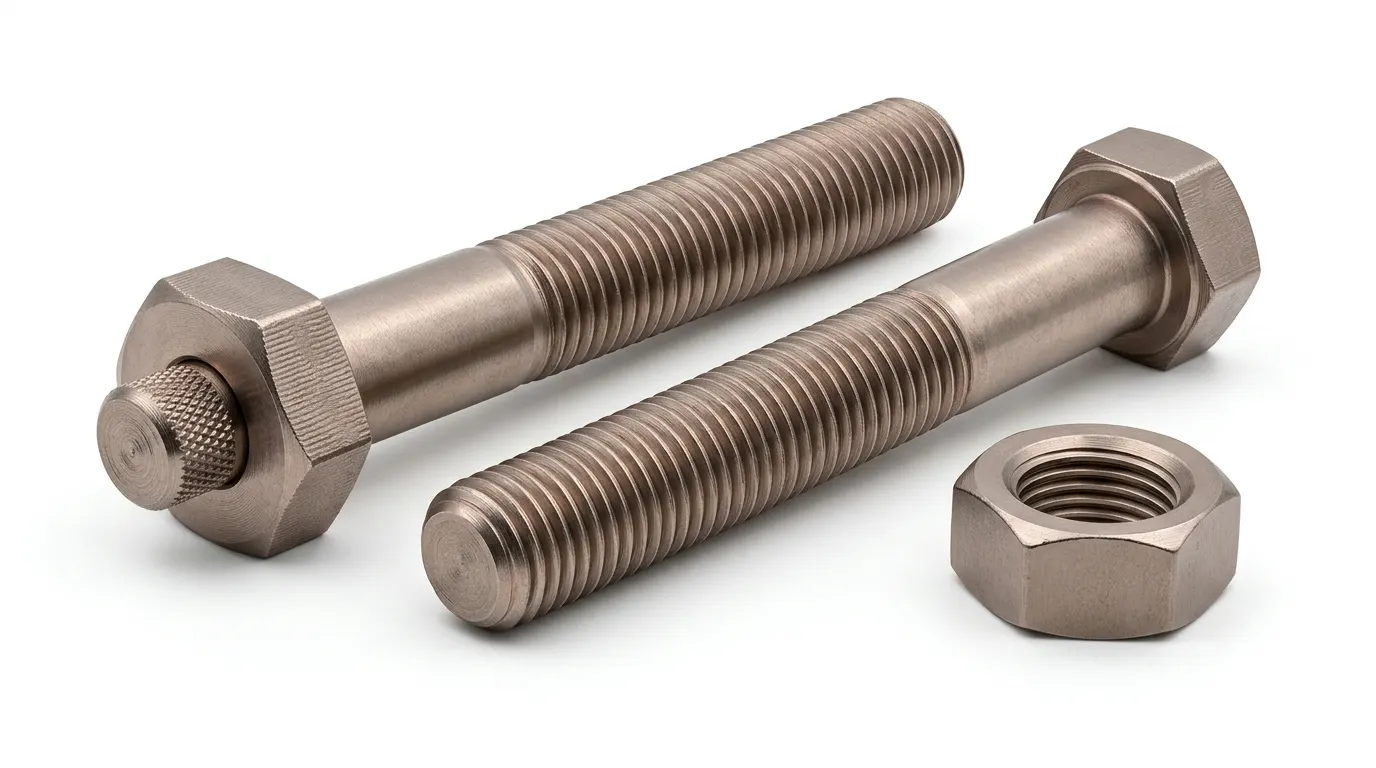
As a globally supplied industrial fastening solution, Monel 400 (UNS N04400 / WNR 2.4360) bolts are widely used in offshore structures, seawater handling systems, heat exchangers, and chemical plants requiring stable performance in reducing and mildly oxidizing environments. These bolts maintain structural integrity even under continuous exposure to flowing seawater, brine solutions, and hydrofluoric acid environments.
We supply Monel 400 bolts to Europe, the United States, and Gulf countries with full material traceability, export certification, and industrial-grade packaging designed for long-haul marine logistics.
Monel 400 Bolts for Marine, Chemical & Seawater Corrosion Resistance Applications
Monel 400 bolts are selected primarily not for extreme mechanical strength but for their exceptional resistance to corrosion in aggressive environments. The nickel-copper composition provides outstanding immunity to chloride-induced stress corrosion cracking, which is one of the most common failure mechanisms in offshore and marine installations.
In seawater systems, Monel 400 maintains stability even under high-velocity flow conditions where stainless steels like 316L begin to pit and degrade. In chemical processing, it performs reliably in hydrofluoric acid and reducing acid environments, making it a preferred fastening material for heat exchangers and acid handling equipment.
Unlike duplex stainless steels, Monel 400 is not dependent on chromium oxide passivation. Instead, its corrosion resistance is derived from its stable nickel matrix, which remains inert under chemical attack.
Chemical Composition of Monel 400 (UNS N04400 / WNR 2.4360)
Monel 400 is a nickel-copper alloy with tightly controlled impurity levels to ensure corrosion stability and mechanical reliability.
| Element | Composition (%) |
|---|---|
| Nickel (Ni) | 63.0 min |
| Copper (Cu) | 28.0 – 34.0 |
| Iron (Fe) | 2.5 max |
| Manganese (Mn) | 2.0 max |
| Silicon (Si) | 0.5 max |
| Carbon (C) | 0.3 max |
The high nickel content provides resistance to stress corrosion cracking, while copper enhances resistance to seawater and non-oxidizing acids. The controlled iron and manganese content ensures structural stability during forging and machining.
This chemistry makes Monel 400 fundamentally different from stainless steels, positioning it as a marine-grade corrosion-resistant fastening material rather than a passivation-based alloy.
Mechanical & Physical Properties of Monel 400 Bolts
Monel 400 bolts offer a balanced combination of moderate strength and high ductility, making them ideal for dynamic marine loading conditions.
| Property | Value |
|---|---|
| Tensile Strength | 480 – 620 MPa |
| Yield Strength (0.2%) | 170 – 345 MPa |
| Elongation | 35% min |
| Hardness | 75 – 120 HRB |
| Density | 8.80 g/cm³ |
| Melting Range | 1300 – 1350°C |
| Thermal Conductivity | Moderate (higher than stainless steels) |
The high ductility of Monel 400 ensures resistance to brittle fracture under vibration and thermal cycling. Its mechanical stability is particularly valuable in offshore piping systems where cyclic loading and seawater exposure occur simultaneously.
Monel 400 Bolts Types & Fastener Forms We Supply
Monel 400 bolts are supplied in multiple industrial configurations depending on mechanical load requirements and installation design.
Hex Bolts are widely used in structural marine assemblies and pressure equipment flanges where uniform torque distribution is required.
Heavy Hex Bolts are used in high-load offshore connections where increased bearing surface is critical.
Stud Bolts are extensively used in pipeline flange systems for oil, gas, and seawater transfer lines where repeated maintenance cycles require disassembly and reassembly without thread degradation.
Threaded Rods are used in anchoring and tensioning applications in chemical and marine environments.
All forms are manufactured with precision machining and controlled threading to ensure dimensional accuracy and consistent torque performance in field installation conditions.
Dimensional Range & Thread Standards (Global Engineering Compliance)
Monel 400 bolts are manufactured in compliance with international dimensional and threading standards to ensure compatibility across global engineering systems.
| Parameter | Range |
|---|---|
| Diameter | M3 to M64 / 1/8" to 2.5" |
| Length | 6 mm to 300 mm (custom up to 1000 mm) |
| Thread Types | Metric Coarse / Metric Fine / UNC / UNF |
| Standards | DIN 933, DIN 931, ASME B18.2.1, ISO 4014, ISO 4017 |
European applications typically require DIN/EN metric standards, while US projects rely on UNC/UNF threading systems under ASME specifications. Gulf-region projects frequently require hybrid compliance due to multinational EPC contractors operating under mixed engineering codes.
Manufacturing Standards & Production Method for Monel 400 Bolts
Monel 400 bolts are manufactured using controlled forging and machining processes to ensure structural integrity under corrosive load conditions.
Raw material is sourced as per ASTM B164 specifications and undergoes controlled cold or hot forging depending on diameter and mechanical requirement. Smaller diameter bolts are cold-headed to maintain grain continuity, while larger diameters are hot-forged to achieve uniform deformation without internal stress accumulation.
Threading is exclusively produced using rolled thread technology, which preserves grain flow continuity and significantly improves fatigue resistance compared to cut threading. This is critical in marine environments where vibration-induced loosening and micro-crack formation can lead to premature failure.
Monel 400 vs Stainless Steel Bolts (Engineering Comparison)
| Property | Monel 400 | SS 316L |
|---|---|---|
| Chloride Resistance | Excellent | Moderate |
| SCC Resistance | Very High | Low |
| Acid Resistance | Excellent (HF, reducing acids) | Limited |
| Mechanical Strength | Medium | Medium |
| Marine Suitability | Excellent | Moderate |
Monel 400 outperforms stainless steel in marine and chemical environments where chloride exposure and reducing acids dominate. Unlike stainless steel, it does not rely on a passive oxide layer, making it more stable in dynamic seawater conditions.
Dissimilar Metal Compatibility & Anti-Galling Behavior
Monel 400 bolts exhibit strong performance in marine assemblies where they interface with carbon steel, stainless steel, or copper alloys. However, galvanic corrosion risk must be managed in highly conductive seawater environments when paired directly with carbon steel components.
Monel 400 has a natural tendency toward galling during metal-to-metal contact under high torque conditions. To mitigate this, controlled lubrication and anti-seize compounds are recommended during installation. In high-load assemblies, surface-treated nuts or controlled torque application methods are used to ensure smooth tightening without thread seizure.
These characteristics make Monel 400 highly reliable when installed using correct engineering practices rather than general-purpose fastening methods.
Applications of Monel 400 Bolts in Global Industries
Monel 400 bolts are widely used in marine engineering systems exposed to continuous seawater flow, including offshore platform structures, seawater piping networks, and desalination plants.
In chemical processing environments, they are used in hydrofluoric acid handling systems, brine heaters, and heat exchanger assemblies where corrosion resistance is critical for operational safety. In oil and gas infrastructure, they are applied in non-oxidizing sour environments where standard stainless steels fail due to chloride-induced degradation.
Their stable performance under both thermal cycling and chemical exposure makes them suitable for long-service-life installations in critical infrastructure.
| Industry Sector | Specific Applications | Environmental Conditions |
|---|---|---|
| Marine & Offshore | Platform structures, seawater piping | Continuous seawater exposure |
| Desalination Plants | Intake systems, heat exchangers | High-velocity brine, thermal cycling |
| Chemical Processing | HF acid systems, reactors | Reducing acids, non-oxidizing environments |
| Oil & Gas | Non-oxidizing sour service | Hydrogen sulfide, chlorides |
Regional Supply & Export Capability (Europe, US, Gulf)
Europe Supply & Marine Applications
For Europe, supply is aligned with EN 10204 3.1 / 3.2 certification requirements and DIN/EN dimensional
compliance, ensuring compatibility with EU pressure equipment directives and marine engineering
standards.
US Supply for Oil & Gas and Marine Industries
For the United States, supply follows ASTM B164 and ASME B18 dimensional standards with NACE MR0175
compliance for sour service environments commonly found in Gulf of Mexico offshore operations.
Gulf Supply for Desalination & Petrochemical Projects
For Gulf countries including UAE, Saudi Arabia, and Oman, supply is optimized for large-scale
desalination plants, offshore oil platforms, and petrochemical infrastructure with fast-track shipment
routes via major ports including Jebel Ali and Dammam.
Quality Assurance, Testing & Certification (EN 10204 / PMI / NACE)
Every batch of Monel 400 bolts undergoes full material traceability and inspection to ensure compliance with international engineering standards.
| Test / Certification | Standard | Purpose |
|---|---|---|
| PMI Testing | ASTM B164 | Material composition verification |
| Tensile Testing | ASTM E8 | Mechanical strength validation |
| Hardness Testing | ASTM E18 | Mechanical compliance |
| Elongation Testing | ASTM E8 | Ductility verification |
| EN 10204 3.1 | Material Certification | Chemical traceability |
| EN 10204 3.2 | Third-Party Verification | Independent testing |
| NACE Compliance | MR0175/MR0175M | Sour service validation |
Certification includes EN 10204 3.1 material test certificates with full chemical and mechanical validation. Positive Material Identification (PMI) testing is conducted to verify alloy composition accuracy. Mechanical testing includes tensile, hardness, and elongation verification under controlled conditions.
Where required, third-party inspection agencies such as SGS, BV, or TUV can perform independent verification to support critical industrial procurement requirements.
Packaging, Export Handling & Logistics Protection System
Monel 400 bolts are packaged using industrial-grade export protection systems designed for long-distance marine and air freight transport.
Each bolt is individually protected with thread caps to prevent mechanical damage during transit. Components are then packed in moisture-resistant wraps to prevent oxidation during sea freight exposure. Finally, shipments are secured in ISPM-15 certified heat-treated wooden crates to ensure compliance with international export regulations.
This packaging system ensures that threaded surfaces remain intact and installation-ready upon arrival at destination ports across Europe, the US, and the Gulf region.
| Region | Major Ports | Export Documentation |
|---|---|---|
| Europe | Rotterdam, Hamburg, Antwerp | EN 10204, Packing List |
| United States | Houston, Newark, New Orleans | ASTM Compliance Docs, NACE Certs |
| Gulf Region | Jebel Ali, Dammam, Doha | COO, MTC, Inspection Reports |
Related Product — Monel 500 Bolts (High Strength Upgrade)
Monel 500 bolts represent the high-strength evolution within the Monel fastener family, designed for applications where Monel 400's corrosion resistance is required but higher mechanical strength and improved load-bearing capacity are critical.
While Monel 400 is preferred for general seawater and chemical resistance applications, Monel 500 is used in more mechanically demanding environments such as high-vibration offshore assemblies, structural marine fittings, and pressure-retaining components where improved tensile strength and hardness are required without compromising corrosion resistance.
Both grades maintain excellent resistance to chloride stress corrosion cracking and hydrofluoric acid environments, but Monel 500 provides enhanced mechanical performance through controlled precipitation strengthening.
Request a Quote for Monel 400 Bolts
For procurement inquiries, custom dimensions, or bulk export requirements, our technical sales team provides fast quotation support with complete documentation, compliance certification, and logistics coordination for Europe, US, and Gulf delivery regions.
Share your specifications or engineering drawings to receive a tailored quotation with material availability, lead time, and export options.
Request a Quote